Research in Progress:
The French ‘Headscarf Affair’ in Non-Theatrical Film: Performing Racialized Gender Under Islamophobic Law. Post-peer review at New Review of Film and Television Studies.
This essay examines the “headscarf affair” in France–a nationwide mediatized debate on the admittance of the Muslim headscarf in public schools–as represented in Her Life (Sa vie à elle, directed and co-written by Romain Goupil, co-written by Zaïda Ghorab-Volta and Jean-François Goyet, 1995) and Mariam (written and directed by Faiza Ambah, 2016). Both films were (co-)written and/or directed by Arab Muslim women and focus on discrimination against Arab Muslim-French teen girls who live in the banlieue–the marginalized urban spaces surrounding central Paris, where a disproportionate number of Muslim people and racial minorities live. Her Life represents the mid-1990s, when headscarf admittance was decided by administrators on a school-by-school basis, providing a useful contrast to Mariam, in which the titular character must decide whether to wear her headscarf directly after the 2004 headscarf ban is passed. While scholarly analyses of Mariam exist, none have been written on Her Life, which can be found only at the Bibliothèque Nationale de France (BnF) in Paris. Drawing on transnational feminist scholars, I do comparative scene analysis to show how Her Life presages Mariam’s critique of Islamophobic policy through its representation of Muslim identity and racialized gender performance. Both telefilms represent the process of negotiating cultural and gender identities in the private and public spheres during key moments of the “headscarf affair.” I argue that the teen girl protagonists ultimately refuse to perform white Western femininity, thus laying bare the institutional sexism and Islamophobia at the heart of anti-headscarf policies and laws.
Select publications
The Western Frontier & American Pulp in la zone: Marcel Carné’s Terrain vague (1960) as Proto-‘Banlieue Film’ JCMS: Journal of Cinema & Media Studies, 2020
This essay examines Marcel Carné’s film Terrain vague (The Wasteland, 1960) as a precursor to post-1980 banlieue (disadvantaged suburbs) genre films due to its representation of the transcultural and postcolonial dimensions of this marginalized space. Carné’s critically disparaged film was produced when US cultural imperialism and the French-Algerian War converged in the metropole. In representing this context, the film presages banlieue film themes and media stereotypes that will intensify in post-1980 France: as the banlieue becomes increasingly racialized, it becomes more troublingly associated with the US ghetto and aberrant virility.
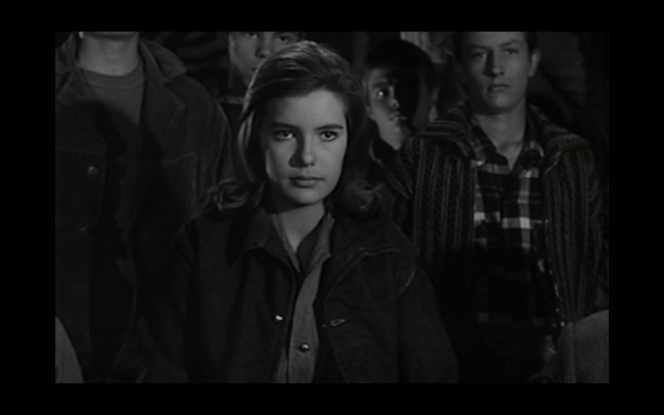
Dan (Danièle Gaubert), a masculine teenage girl, leads the gang in Carné’s Terrain vague (1960) (René Chateau Vidéo)
Truffaut’s L’Enfant sauvage (The Wild Child, 1969): Evoking Autism & the Nascent “Eugenic Atlantic.” Ought: The Journal of Autistic Culture, Dec. 2019.
This essay analyzes François Truffaut’s L’Enfant sauvage (The Wild Child, 1970) as an early representation of autism that metaphorizes the neurodiverse child as the colonial subject. The film takes place in 1798, only a decade after the French Revolution, and depicts the true events of the “wild boy of Aveyron,” a feral child found in the Southern French forest when he was twelve years old. Before the film’s production, Truffaut—who also plays the boy’s teacher, Dr. Jean-Marc Itard—collected articles and books on autism and viewed videos of autistic children to create his main character’s behavioral patterns. The film is thus an exceptionally early representation of autism in narrative film history. While several scholars have analyzed the film with this knowledge—and usually from an autobiographical point of view that uncritically celebrates the film’s auteur director—I merge the critical lenses of disability studies and postcolonial studies to examine it as a white savior film.
Drawing on archival research and considering L’Enfant sauvage’s narrative and production contexts, I explore how the film evokes what Snyder and Mitchell term the “Eugenic Atlantic”—the historical moment when racial and disability eugenics dovetailed at the end of the eighteenth century. The film not only maintains that the boy should be “civilized” in its representation of Itard as the narrative’s hero, but it also conflates disability and race via the following production and formal choices: the casting of a Romani boy (Jean-Pierre Cargol) despite Truffaut’s knowledge that the historical “wild child” was white; and the use of long and iris fade-out shots that work to distance the audience from identifying with the autistic child, most notably in scenes where he connects with nature as he stims (uses repetitive motions to self-stimulate). In its representation of autism-as-savagery only a year after May ’68—a key moment in postcolonial French history—L’Enfant sauvage reveals some of the ways in which colonialism and ableism are mutually imbricated historical methods of normalization that span centuries.
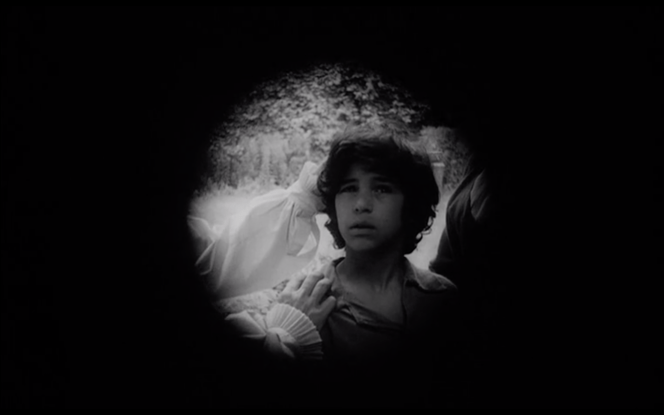
Itard’s (Truffaut) patronizing touch echoes the iris shot–and medical gaze–that constructs Victor (Jean-Pierre Cargol) as abnormal in Truffaut’s L’enfant sauvage (1969) (Les Films du Carrosse)

